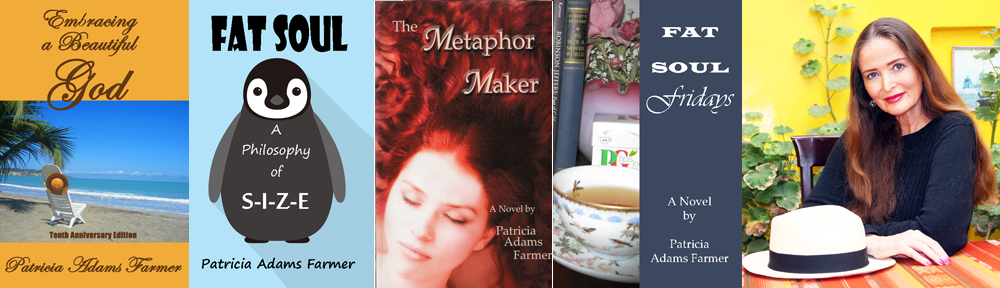
Patricia Adams Farmer is a pastor, writer, animal lover, chocolate enthusiast, classical guitarist, and author of several books in the areas of spirituality and process theology. Check out a complete list of her essays on Open Horizons (openhorizons.org) and her "Process Musings" blog posts at Spirituality & Practice (spiritualityandpractice.com),
Starting to make plans for a winter retreat? I hope you will consider spending it with me. February 3-28, I’ll be teaching an online course called “Living with Beauty” at Spirituality & Practice. You can also give this e-course as a gift! During the season of gift-giving, I hope you will consider giving the gift of beauty to someone you love. Follow this link to learn more. You can click “give as a gift” at the bottom of the page. You may want to gift yourself, too! I look forward to being your guide and companion on this journey of the spirit . . .
We can then see our own suffering as a voluntary participation in the one Great Sadness of God. . . . Within this meaningful worldview, we can build something new, good, and forever original, while neither playing the victim nor making victims of others. We can be free conduits of grace into the world. — Richard Rohr
Recently, my young cat named Oliver struggled with a painful illness, and it occurred to me that my own deep sadness over his distress was something much bigger than me. Remembering a line from Franciscan priest Richard Rohr, I even found myself saying, “It is the Great Sadness.” It was as if my cat’s suffering was noted and felt and permeated with that same Great Sadness that mourns the death of bees, that same Great Sadness that feels the groans of refugees and hurricane victims and gun violence. Yes, that same Great Sadness feels the suffering of this tiny gray rescue cat. It is the one Great Sadness of God, a sadness that invites us to participate. And when we do, we become channels of grace to the world. . . . (read more)
In the spaciousness of uncertainty is room to act. — Rebecca Solnit
In her book Hope in the Dark, writer and activist Rebecca Solnit argues a strong and eloquent case for uncertainty. Uncertainty? But . . . no one likes that word. Don’t we often remark that the worst part of waiting for news about a diagnosis or a lost dog or an unpredictable hurricane is the “uncertainty”? Today, we face serious, existential uncertainties in the larger world: Will we finally address climate change before it’s too late? Is it, in fact, too late? How much more violence will we see before hate runs its present course? Will our democracy hold? All this uncertainty makes us crazy. That is, until we discover the riches inherent in uncertainty. . . . read more
We must risk delight. We can do without pleasure, but not delight. Not enjoyment. We must have the stubbornness to accept our gladness in the ruthless furnace of this world. — Jack Gilbert, A Brief for the Defense
For all who feel deeply about the world, for all who mourn a planet under siege, for all who care about justice and human dignity and democracy and the welfare of the most vulnerable — these are hard times. Shocking and dispiriting days. I feel it, you feel it.
When is it all going to turn around? It will turn around, I’m convinced, but at a great price of waiting too long. My theory is that we humans are an eleventh-hour species, waiting until it is almost too late to do anything to save ourselves. But we do, history tells. We do. Barely. By the skin of our teeth. While the future remains open with no guarantees, I truly believe that the current moral sickness will break like a fever and we will see better days. And we who care and dare and dream and choose kindness are part of that recovery, even if we can’t see the results at present.
But this is little consolation while morality and human decency continue to go south. For example, you may be made of sterner stuff, but when I hear hateful, toxic rhetoric day after day, the words seem to waft out from my TV, settling on my skin, leaving behind a layer of dirt and muck. There is no use trying to deny what’s happening or run from it — we can’t. There is no use wallowing in despair — we mustn’t. What we can and must do is be attentive to our souls in the midst of our work for better days. . . . (Read More)
MY WRITING finds inspiration in a particular view of the world called
process thought. Process thought is not
a religion; it is a philosophy. But this philosophy is friendly to people of
all faiths and traditions. In fact, this particular worldview, most identified
with the work of mathematician and philosopher Alfred North Whitehead, stirs
one’s deepest spiritual inclinations, even for the irreligious. But, one might
say, if I already have a religion—thank you, very much—then why do I need to
think beyond that? Do we really need a philosophy or is it just so much
head-talk?
We all have a philosophy-of-sorts going on in our heads at all times,
whether we are conscious of it or not. Each of us comes to a religious text or
tradition wearing philosophical glasses: certain assumptions we have about the
world and about the people and animals that make it up. That’s why people who
read the same sacred text can end up either a Pat Robertson or a Mother
Theresa, a Hitler or a Martin Luther King, Jr. It’s all about what you bring to
your religion: those hidden assumptions created by your cultural and psychological
influences, your prejudices and traumas, your understanding of power and
relationships and meaning. So, becoming aware of those assumptions that color
our religion and the way we treat others and our planet is a good thing. That’s where philosophy comes in: it helps
clarify our sense of meaning and our values. It helps us in our wondering, too. As
Professor C. Robert Mesle says, “Philosophy is born of wonder; it is the
art of wondering in a disciplined, thoughtful way.” Philosophy can even help
us with our theology. After all, many of our theological assumptions come to us
via the great philosophers of the past. Many of their ideas were good ones; others,
not so much–or at least, severely outdated.
Take me for instance. During my seminary studies, I couldn’t get past the
“problem of evil and suffering,” so my Christian faith took a reluctant
and despondent nosedive into agnosticism. I could not, in good conscience,
believe in God in the face of horrible realities like the Holocaust. After poring over all the traditional
“theodicies” that tried to save a traditional God, i.e., an
all-powerful, all-good God, my search finally came to a dead end. My spiritual
life had become one huge sigh of regret. That’s when I took up the study of philosophy
at the University of Missouri and became a teaching assistant. One day, as I was preparing to teach an Intro
to philosophy class, one of my professors handed me a copy of a journal article
by Charles Hartshorne about Whitehead’s view of God and the world. I devoured the article and signed up for a
seminar on Whitehead. It was the beginning of my life-long love affair with
process thought!
I was intrigued by Whitehead’s concept of a relational God which cut against
the grain of the traditional view of God defined by Western philosophy (and
duly adopted by Western theologians). In
Whitehead’s philosophy, the all-powerful, supernatural ruler of the universe
gives way to the relational, transforming “poet of the world.” The
traditional Greek concept of “perfect power” as “unilateral
power” was turned on its head in this cosmology. Relational, persuasive
power takes center stage in Whitehead’s “philosophy of organism.” So,
God began to make sense again, this time as one who “dwells in the tender
elements in the world, which slowly and in quietness operate by love.”
(Process and Reality, 343)
But God was only part my personal “Copernican
Revolution.” Whitehead’s radically open and interconnected view of the
universe–a monumental break from Cartesian dualism–also made sense to me in
light of quantum science. Everything began to make sense– not just my
relationship to God, but to the pelicans and the tree frogs and bees. I no
longer had to choose between science and religion–what a relief!
Finally, after reading John Cobb, David Griffin, and Marjorie Hewitt
Suchocki, three brilliant process theologians from the Whiteheadian tradition,
I was able to return to my Christian roots—albeit with a radically fresh
understanding of God and the world. I even became a minister and introduced my
husband, a biblical scholar, to process thought. (He ended up writing a seminal
work on process hermeneutics.)
But process thought is not just for Christians-in-crisis—not by a long shot.
Some of the finest process theologians today are Jewish (e.g., Rabbi Bradley
Shavit Artson) and Muslim (e.g. Farhan Shah). Many traditions East and West are
currently in dialogue with Whitehead–Buddhism for example, which, like process
thought, has always been a relational, interconnected way of seeing the world.
Buddhism makes sense in light of process thought–a great deal of sense. In China today, with its event-oriented
language and rich philosophical history, Whitehead’s thought is blossoming.
Process is big-tent philosophy for anyone of any faith — or naturalists,
environmentalists, and those who have an understanding of spirituality that
stands outside of any particular religious tradition.
Process thought allows me to embrace my own tradition even while I deepen my
appreciation for other spiritual paths. In a nutshell, process engenders
empathy. So beware of becoming a process thinker! You will be infused with and
challenged by empathy, and that changes everything. Heaven forbid, it
might even change your life direction! It did mine. In fact, that’s why I love
writing fiction: It allows me to get inside the skin of my characters.
Characters who are unlike me. Characters with different views of the world,
different religions, different hang-ups, different genders and sexual
orientation. Yes, I want to feel with
them and know them and present them to the world. This need to empathize
in storytelling bubbles up not only from artistic passion, but because of
process thought: a lovely luminosity in my life and soul.
For process thought is all about expanding our souls to embrace contrasts
and differences in a richly interwoven world that is always in the process of
becoming. It’s about seeking beauty in our relationships, not only with people
who are different from us, but with animals and the planet and very air we
breathe. And in this world of religious conflict and environmental disaster,
such a philosophy as Whitehead’s—one which promotes beauty and justice and
relational harmony among all living beings—well, it couldn’t hurt, could it?


 Patricia Adams Farmer