The Tiny Philosopher of Wonder

Whitehead famously said, “Philosophy begins in wonder.” If that’s true, then my rescue kitten, Raindrop, may be the greatest philosopher of all time.

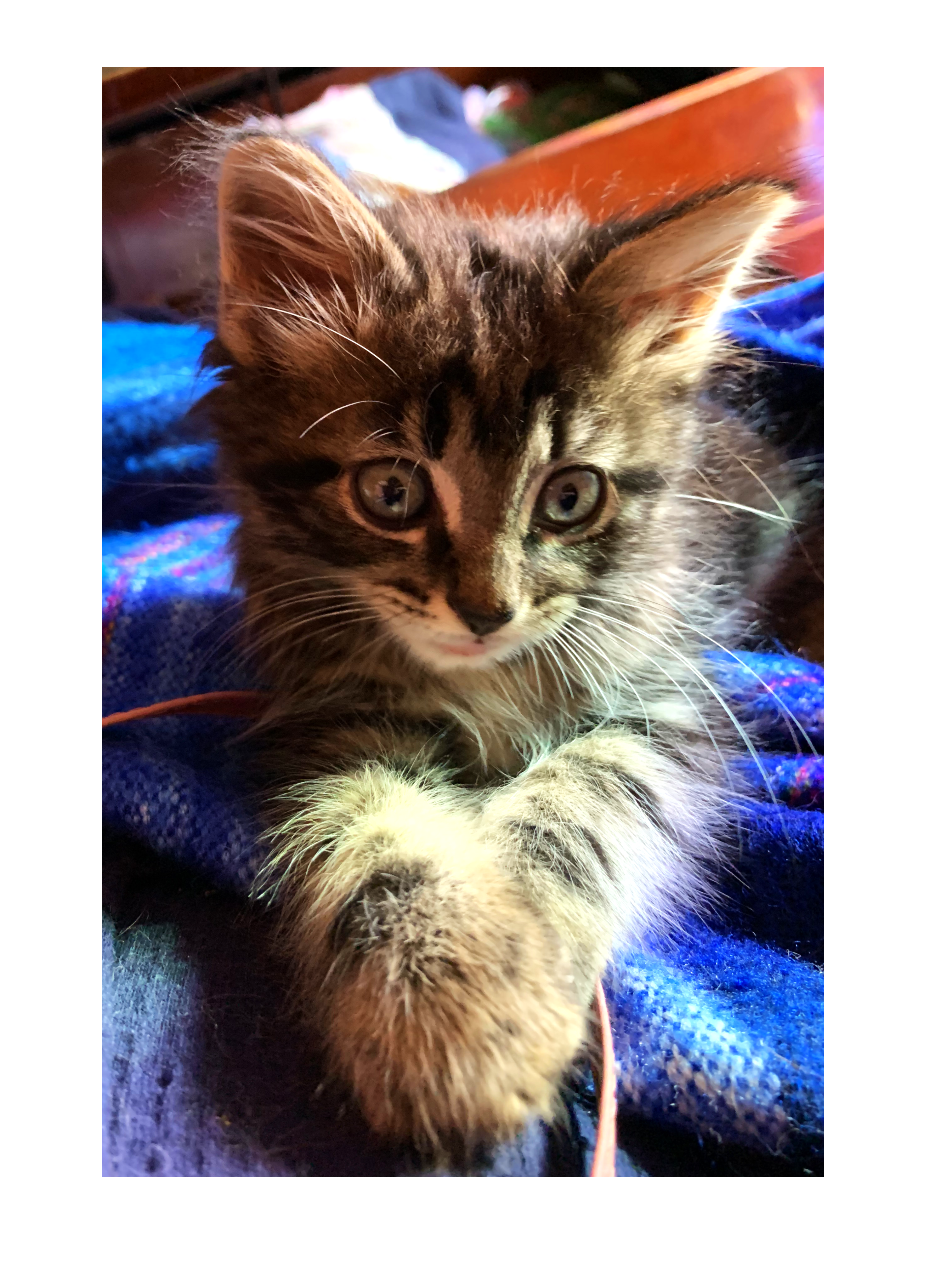
While trail walking on a rainy Spring morning in early June, my husband and sister-in-law and I heard the urgent, distressing meow of a cat in a green thicket near a creek. We thought it must be a bigger cat, given the sheer volume of its voice, but when we finally coaxed it out of the bushes, we saw that it was a tiny scrap of life, alone, soaked, starving, and full of tics and brambles. Thanks to his persistent cries, he was saved. And fed. And loved to the hilt.  

Eat, Play, Love

He-of-the-big-voice inhabits the tiniest of bodies (possibly the runt of a litter), who we hope will soon begin to fill out with our care. But tiny is huge in the realm of what matters. I realized after a week of caring for him, that he has so much to teach me. His needs are simple: Eat, play, love. But the wisdom from this relationship — kitten and me — goes much further.

Raindrop rekindles in me that foundational value of wonder that undergirds the best of spiritual traditions, poetry, science, and philosophy.

Philosophy literally means “the love of wisdom,” and I have dedicated much of my adult life to the study of philosophy and theology for this reason; but wisdom, I have discovered, comes not just from intellectual concepts, theories, and ideas; wisdom also comes to us through the wonder of nature, the earth, the body, the universe, intuition, imagination, music, art, and religious life. Wise thinking does not get caught in the hall of mirrors of its own logical certainties but returns with humility to the wonder-filled world of tiny, lost kittens and rain and the struggle to survive.
Divine Wonder

The gift of wonder comes from beyond us; it issues forth from divine places, both in heaven and earth, in sorrow and in laughter, in play and in love, in ritual and in music. The greatest thinkers are those who understand this.

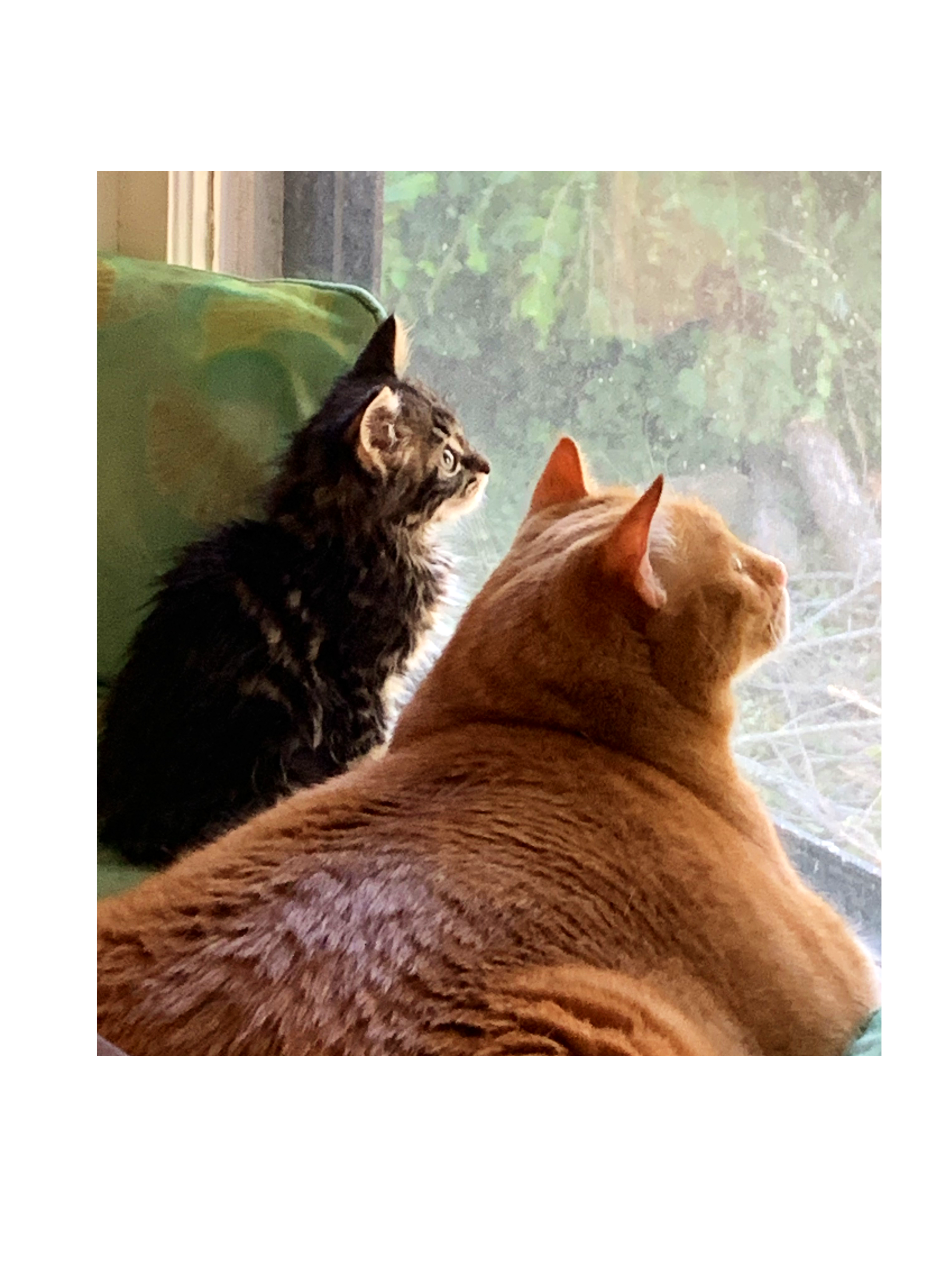
Raindrop knows something about wonder. He is full of it, all 1½ lbs. of him. Everything sings and shines and calls out to be noticed: the sounds and movements from television, a toy ball that lights up, a soft pile of towels in which to sleep and dream. Everything is brand spanking new, fresh, scary, and wonderful — everything, the whole “kit-ten” caboodle — from the ecstasy of his first lick of butter to the fear and awe inspired by his 20 lb. ginger brother.
Radical Amazement

In a state of wonder, we grow our souls, become curious and open-minded. Our creativity blossoms, and our empathy deepens. In a state of wonder, we become wholly present in the moment. Raindrop doesn’t worry about the future when watching squirrels and birds from his window perch. He doesn’t remember being abandoned and lost. He is too enraptured with life! At every turn, with every new discovery, his slanted green eyes grow large and full of nothing less than what Abraham Joshua Heschel’s called “radical amazement.”

Raindrop teaches me other things, too: when you’re in need, meow loudly until someone pays attention! Be persistent. Practice curiosity. Stand in awe at the bigness of the world. And, if everything around you is growing dark and scary, look for the patch of light streaming through the window and park yourself there as long as you need.

Be Astonished

It all begins with wonder. We can all be philosophers of wonder, with the wisdom that we are very small creatures in the scope of the vast universe. As Mary Oliver put it:

“Instructions for living a life.

Pay attention.

Be astonished.

Tell about it.”

We need these instructions more than ever. These are indisputably dark days, so it’s good to be reminded through our pets and children and poets how to live in a continuous state of awe and astonishment which keeps the door open to hope and fresh possibilities. For wonder is a form of deep intelligence that can host empathy, wholeness, and deep spiritual awakening.

The Wonder Remains

Of course, many great thinkers begin with wonder, but then lose it along the way as they get further into breaking things apart in the intellectual quest for knowledge. Things begin to be devitalized and life becomes bits and pieces of knowledge with no real embodiment. But knowledge is not wisdom. Intellectuals often forget to return their attention to what’s most real — and most important: the living, messy, ambiguous world. Good philosophy points back to the world, to nature, to the whole web of relationships that make up life. Wise thinkers balance their abstract concepts and ideas with wonder and mystery and the humility of being a tiny being in a huge universe.

It’s important to note that Whitehead did not only say, “Philosophy begins in wonder,” but he added significantly, “And at the end when philosophic thought has done its best the wonder remains.” The wonder remains! That is the key.

We all know that life itself begins in wonder, but for how many of us does wonder remain? We grow old, cynical, and forget who we are: stardust in a vast and beautiful universe — a part of the Great Mystery of Being.

Yes, Raindrop can tell us something about being a tiny tyke in a big, scary world, and how to see this vast world through a lens of wonder, awe, and pure astonishment. When I immerse myself in the wonder of my own aliveness —  the tickle of rain on my skin, the delight of a good meal, the pang of loss, the joy of finding a lost kitten — I feel a deep conviction that this tragic and beautiful world is somehow held together by love.  

And it all begins — and ends — in wonder.

Miss Harbottle’s Big Mistake (And Why it Matters to Us)

The enchanting Masterpiece series All Creatures Great and Small features a crochety but loveable Yorkshire vet, Siegfried, and his brilliant young partner, James. In this series, based on the real-life stories of James Herriot, the two vets have a policy of “putting the animal first,” that is, above profit. Yes, it’s rather scandalous — even in the 1940s — for profit to be put on the backburner in favor of living, breathing animals. But it’s not just cows and goats and dogs that come first. Their compassion for the animals’ owners require the two vets to be flexible on occasion — that is, to accept jam and eggs and the odd chicken as payment when they really need hard cash. But they do it because they not only care for the animals; they also see the fuller picture of community well-being and the need for caring for their neighbors. They live within the creative tension of compassion and making ends meet.

But of course, these beloved characters are imperfect like the rest of us, so sometimes they make the wrong call. Such was the case in Season 4, in which Siegfried, overcome with the tyranny of mounting paperwork and general office chaos, decides to hire Miss Harbottle, an uber efficient secretary, to come in and straighten up things. Sounds perfectly reasonable, right?

Miss Harbottle certainly cleans up and organizes the chaos. But in the process, she begins to take control of everything, telling the doctors what they could and could not do, taking over Siegfried’s own office as her own, and generally alienating everyone with her rigid rules and domineering ways. On her first day, Miss Harbottle takes a disgusting dislike to Siegfried’s beloved pet rat, Volonel, whose cage sits next to his desk, and takes it upon herself to banish Volonel to a dark back room.

This would not stand! Siegfried returns Volonel to his proper place and even tries to muster the courage to fire Miss Harbottle. But alas, his resolve crumbles against her rigid, manipulative dominance.

One day, a man named Joe Coyne brings in his little white ferret, Wilf, who is suffering from a lump on his skin and needs surgery. Miss Harbottle turned him away for not making “a proper appointment” or paying in advance (her new policy). Joe stomped away with his ferret in tow, vowing never to return.

That act proves to be Miss Harbottle’s undoing. Because the “animals first” policy is so brutally disrespected, James and Siegfried conspire to bring Wilf in for surgery after Miss Harbottle leaves for the evening. But alas, the formidable Harbottle returns for the post she had forgotten and encounters this “unauthorized” operation in progress. Livid, she decries, “You went against my authority!” Upon which Siegfried responds, “an authority I should have never relinquished.”

Of course, Miss Harbottle is dismissed on the spot and life returns to its normal creative chaos. An entertaining story, for sure, but it also reminds us of the tensions within human nature and, on a deeper, spiritual level, reveals something of what is wrong with the world even now.

Miss Harbottle as Metaphor

Miss Harbottle is the perfect metaphor for what philosopher, psychiatrist, and neuroscientist Iain McGilchrist calls “left-hemisphere dominance.”  His “hemisphere hypothesis” is that the left hemisphere of our divided brain has an important role to play in our lives, but it is a limited one that serves the broader view of the right hemisphere — like a camera zooming in to grasp, isolate, and manipulate (left-hemisphere) and then zooming out to see the larger context (right hemisphere). We need both perspectives in order to survive and thrive. The problem comes when the left hemisphere goes rogue and takes over (i.e., Miss Harbottle). When this happens, we lose perspective and life becomes mechanical, shallow, literal, fragmented, and lifelessly static.

Like Miss Harbottle, the left-hemisphere simply can’t see the whole picture, the broader context, and the relational aspects of existence. It believes it is always right, seeks to control, and gets angry when confronted (anger being the prime emotion of the left-hemisphere).

When we (individuals or whole societies) allow this part of our thinking to be our dominant view of reality, we become rigid and limited in our thinking, cut off from the real world of flesh and blood and feeling, and from the spiritual world that gives meaning and purpose. We are inviting tyranny into our lives.

McGilchrist does not reduce the mind to the physical brain as do scientific materialists, but rather sees the brain’s two hemispheres as a physical home for our consciousness. How we use our brains becomes a moral and spiritual choice. As his decades of research shows, we can open ourselves to meaning, spirituality, and beauty only when our brains are balanced, with the right hemisphere being the master and the left, the helper.

In his massive (and massively important) work The Master and His Emissary, he tells a fable which could easily be Siegfried and Miss Harbottle: a master becomes overcome with too much work to handle and hires an emissary to help. But the emissary begins to take over. In the process, life — human, animal, creation — along with compassion and an intelligent sense of the broader picture is lost in the small and narrow focus of left-hemisphere tyranny. Relations are fractured, rigidity rules, and catastrophe ensues.

Miss Harbottle’s big mistake was not her efficiency and skill, which was sorely needed, but her desire to take over with rigid rules that look good in the abstract, but fail miserably in reality. She failed to see herself as a “helper” and took control over the vet practice, leaving soured feelings and fractured relationships. She couldn’t see the larger context in which she worked — the real world of struggling country folk, suffering animals, and delicate village relationships.

When the left hemisphere overreaches its authority and does not return attention (zoom out) to the larger, living, breathing, interconnected world, bad things happen. Devoid of the right hemisphere’s larger, more intelligent and contextual view of things, farmers and ferrets become mere numbers and abstractions rather than living beings.

The sense of interconnection, flow, and all the values of the spiritual life are lost in the emissary’s grasp for power. Our openness to the Divine and to the higher values of goodness, truth, and beauty — all that makes life meaningful — depends on our choice to return our focus to the master, i.e., the right hemisphere. But how?

A is for Attention

McGilchrist emphasizes that the brain hemispheres attend to the world differently, and that, yes, we have a moral choice in the matter. Like Siegfried, the modern world has relinquished much of its power to the emissary. It appears we are stuck with the tyranny of Miss Harbottle until we have the courage to push back and make moral choices that bring our brain hemispheres into balance, opening us up to the richness and depth of love, beauty, and compassion above the rigid, narrow focus on money, power, and control. It will take a change of viewpoint — of attention — and some soul-searching to rediscover what matters.

Another way of putting it: we need to enlarge our souls for the sake of the world. The right hemisphere’s take on the world is broadening and well-rounded, while the left hemisphere lacks depth, complexity, and flexibility. So perhaps enlarging our attention is the first step to enlarging our souls. After all, “A” is for attention in the “Alphabet of Spirit Literacy.” Perhaps it is first in importance, too, or at least foundational to all the other spiritual values. If we choose to attend to the world of left-hemisphere narrowness, we will be impoverished to the point of putting our very existence in peril. The spiritual part of us needs the right hemisphere’s way of attending: seeing the whole context, the flow, and the relationality of God and the world. None of this makes sense to the rigid, literal, and abstract oriented left-hemisphere.

The Courage to Push Back

The struggle between Miss Harbottle’s narrow approach to the world and Siegfried’s attention to larger issues serves not only as a cautionary tale but an insight into our humanity and what we must regain in order to survive these perilous times. Many of our religious and spiritual values have fallen by the wayside — or been usurped by false prophets. By fattening our souls rather than our wallets, by enlarging our experiences with nature, art, and face-to-face interactions, and by broadening our minds to learn and listen to the views of the “other,” we might just regain our humanity and survive as a species. But it’s going to be an uphill battle. The Miss Harbottles of this world are a formidable lot!

But there is hope. In our story, when things fell apart in the vet practice, Siegfried had the courage to admit he was wrong in relinquishing his authority to Miss Harbottle. He was finally able to push back against the tyranny and return to his foundational values of relationships and compassion over profit and power. Yes, Siegfried had the courage to return his attention to what really matters. The question is: Do we?