“Living with Beauty” is Back!

Feeling the need for an immersion in Beauty? As we begin the season of coats and hats and busy holidays, perhaps a “Beauty Break” is in order. Spirituality and Practice just informed me that my e-course “Living with Beauty” is returning on Monday, November 10. It would make a great gift to yourself or to a friend:

“Beauty is that which glistens on the edges of our yearnings and lures us into the depth of things.”
— Patricia Adams Farmer, Embracing a Beautiful God

Whether we are contemplating a work of art or the striking form of a red cardinal against a snow laden tree branch, the experience of beauty involves us in something larger than ourselves. We feel pulled into the experience as if called into another world. Suddenly, we are attuned to a deeper reality that is both welcoming and transforming. The experience of beauty, in this view, is a taste of heaven on earth, the very dream of God for all creation. The early twentieth-century philosopher Alfred North Whitehead suggests this when he states: “The teleology of the Universe is directed to the production of Beauty.” Seen in this light, beauty can transport us “into the depth of things,” serving as a catalyst for meaning, gratitude, hope, and planetary well-being.

This e-course, “Living with Beauty,” explores how the experience of beauty found in nature, art, music, poetry, religious ritual, and the quotidian of daily life can enlarge our souls and offer great solace and delight — even as it “lures” us into new ways of thinking, creating, and imagining a better world.

You will receive 12 emails, sent on Mondays, Wednesdays, and Fridays starting on November 10. In each e-mail you will find:

  • Insights into the nature of beauty from the great wisdom traditions, philosophers, poets, mystics, and religious texts.
  • Reflections on beauty’s transforming possibilities, even in times of darkness and tragedy.
  • Artistic prompts for contemplation (and discussion in the online Practice Circle), including nature photography, paintings, poetry, and links to music.
  • Practices for taking regular “Beauty Breaks” as we explore ways of tapping into the hidden beauties all around us.
  • An invitation to share in our online Practice Circle where you can respond to each session.

Patricia Adams Farmer (patriciaadamsfarmer.com) is an ordained minister and author of several books including Embracing a Beautiful God, Fat Soul: A Philosophy of S-I-Z-E, and Replanting Ourselves in Beauty: Toward an Ecological Civilization (co-editor with Jay McDaniel). She has led retreats and conferences on beauty and the spiritual life in both the US and Canada. After a recent five-year adventure of living and writing in Ecuador, she now lives in the Midwest and writes for several websites, including a co-authored blog for Spirituality & Practice called “Process Musings.” She lives with her husband, Ron Farmer, and two feline studies in beauty, Alfie and Raindrop.

Click here to register!

When You Don’t Feel at Home in the World Anymore

When you don’t feel at home in the world anymore, 
sit down by a flowing brook.
Open your palm to the wet, smooth stones.
Listen to the gurgle of water against rock --
the music of quiet resistance.

When you don’t feel at home in the world anymore,
revisit old friends in books you treasure,
or familiar melodies that break your heart.
Most of all, remember the wise ones now gone:
those who dared to swim upstream
and imagined a better world.

When you don’t feel at home in the world anymore,
find friends who laugh,
write a song,
bake bread,
love your neighbor.
Create a footprint of defiant joy --
and walk that path.

When you don’t feel at home in the world anymore,
do not close the door, as tempting as it may be.
Take the gifts of your history,
what you love,
and move forward into the unknown -
the uncertain,
the undiscovered.
Be a pioneer if you have to.

When you don’t feel at home in the world anymore,
at least feel at home in yourself.
Ground yourself in the flow of
the good,
the true,
the beautiful:
the poetry of God.

You see, the world has not ended.
Nothing is finished.
The universe flows on —
and so do you.

Patricia Adams Farmer,
In memory of two “wise ones” who dared to swim upstream:
Dr. John B. Cobb, Jr.
and President Jimmy Carter

Aging in a New Key: The Spiritual Benefits of Learning an Instrument in Later Years

After my 68th birthday, I felt an inexplicable urge to learn to play the piano. At my age? Come on. Had I suffered a stroke? I resisted, of course; it made no sense. But the desire wouldn’t let up.

Finally, after repeated attempts to quell this longing, my husband hauled up an old digital keyboard from the basement that friends had retrieved for us at a rummage sale in case we might need it someday. Well, that day had come. I felt that even this dated keyboard could be a trial run to test my new passion — better than blowing my retirement savings on a Steinway. I reasoned that I would wake up and come to my senses, eventually returning the keyboard to its dusty place in the basement.

Yet, with every practice my  passion only grew. I knew this was the real thing — a late-in-life calling that felt somehow sacred. Could this be my new spiritual practice?

This impulse toward beauty in the form of piano music is, in my mind, a  divine lure from somewhere inside my soul, speaking to me: “Just do it. Forget your age. Forget how to ‘use’ it in real life. Forget being good at it. Forget trying to impress or even perform. Just do it!”

Much has been written about the amazing cognitive benefits of learning a new instrument later in life, but the articles usually stop there. What about the spiritual aspects? How can it expand the soul?

Here are a few immediate benefits I have discovered:

  • Attention: The brain and spirit work in tandem. The cognitive benefits I have noticed, such as memory improvement and the ability to focus better, infuse my life outside of music. I can now focus without effort on a book or a conversation with friend. This strengthened sense of mindfulness keeps me from burning our supper, stumbling over the cats, and even enhances my meditation practice.
  • Patience: Learning a new instrument takes a long time in later Iife. Although my brain is not even a fraction as quick as it was as a child, I have patience in spades. And that patience grows and manifests itself in the real world with friends and family and long lines at the grocery checkout. It takes patience to simply grow old. Music practice is a patient builder.
  • Kindness: There is no room for lambasting myself for having a bad practice day or not getting the fingering right. I remind myself that I am learning for the joy of it, not to impress anyone or meet some high standard. In other words, I am finally learning to be kind to myself. I can accept and love whatever the practice brings. This kindness I practice towards myself then hurls itself toward others in my path. I realize how we are all struggling to get through the tasks before us the best we can.
  • Humility:  It is a humbling act for an older adult to begin a new instrument at beginning level. No bragging rights here. Perfection has no place in this endeavor. It is all about the adventure, the tiny but thrilling moments of “getting it” and improving. It is humbling and freeing to let go of the old demands we place on ourselves as youth and simply enjoy participating in the world of music, even in a small, humble way.
  • Persistence: Not until your fingers are literally aching from playing the first bars of “Für Elise” over and over — and over again — do you understand the meaning of persistence. (Für Elise, the obligatory piece for beginning pianists has been recently renamed “Furry Lise” by my two cats.)
  • Wonder:  Simply being a part of the wonder of music keeps me enthralled, heightening my sense of awe. After all, I am participating in the same spirit that infused Bach and Beethoven and Chopin and John Lennon. Getting in touch with the invisible flow of something beautiful that spans centuries and points to something beyond the miseries of this world, can be a spiritual experience in itself. Here, I am inspired by my friend, Jay McDaniel, a theologian and musician, who has taken his own music into memory care units and witnessed transformation in patients. He has written elegantly extensively on the metaphysics of music and its power to transform. For starters, check out: “Open and Relational Music Makers” and “Saving Mozart.”
  • Solace: According to Albert Schweitzer, “There are two means of refuge from the miseries of life: music and cats.”  My cats and I fully embrace this philosophy. Music, whether played, sung, or listened to, is a sanctuary in a world of growing meanness, a world that continues to diminish the arts, beauty, and all the finer feelings  – compassion, empathy, and kindness. Music is a retreat that changes the listener and so changes the world. Even the tiniest moments of beauty are woven into the fabric of the world, changing the texture of how we experience the world and how we envision the divine.

Aging in a New Key:

As aging adults, we often define ourselves by our limitations. We grow weary of doctor visits, works outs, pain management, and often loneliness. These challenges await those of us fortunate enough to live long lives. But music reminds us of something more. It helps us transition into a new key, one that we never knew existed.

Learning an instrument increases our well-being, our sense of purpose, and a world beyond mere limitation. We find that even within our limitations, possibilities we never imagined can nudge us into fresh realms of adventure and joy.

After being diagnosed with advanced glaucoma, I felt my world narrowing along with my eyesight. No longer can I spend hours in front of computer or enjoy the details of a face or a butterfly or a work of art; but this visual limitation has opened up a new world of aural possibility, with music taking on heightened importance. Through my limitations, I have discovered a new sense of aliveness and joy.

Aging is more than limitation and the narrowing of the field of possibility. In fact, aging offers us a portal into fresh adventure not possible in young adulthood or even middle years. If we dare to step through this portal, we enter the deeper mysteries of life in a way we could never see when we were hell-bent on racking up accomplishments and getting ahead. In our senior years, when the ego needs fall away like a discarded chrysalis, we can finally unfurl our spiritual wings.

Music can help us fly.  

Death is a Kind of Gravity

Death is a kind of gravity,

a letting go, a natural tug down --

down toward the earth,

toward dust,

toward the heart of the world.


So too for those left behind.

The gravity of grief pulls us,

against our will,

down into Earth’s Heart,

the essentials, the center:

what matters.


I think of the Universe

as God’s body,

beautiful and tragic as it is.

So perhaps God is not

a remote king, judging, controlling,

manipulating from on high,

but earthy, involved, feeling the

pain of everything,


like the suffering and compassionate Jesus –


Like Michelangelo’s La Pietà:

a mother, grieving --

a loving heart who cradles us

in the tender embrace that is both

earth and sky,

spirit and soil.

tragedy and joy.


The great Heart of the Universe sings to us in our grief

a dreamy melody, luring us down into

the depth of things –

a sacred song that winnows out the chaff

of busyness and striving,

all that distracts us from our inner lives.


Then we can finally slide down into what matters:

truth, beauty, goodness,

and, most of all,

forgiveness,

love.


The Divine Tenderness is that welcoming embrace

that catches everything as it falls:

dragonflies and people,

flowers and dreams,

all to be reborn, restored, resurrected

in the great womb of God.


Gravity takes us home.


--"Death is a Kind of Gravity" by Patricia Adams Farmer, in memory of Mary Farmer Wiebe

The Tiny Philosopher of Wonder

Whitehead famously said, “Philosophy begins in wonder.” If that’s true, then my rescue kitten, Raindrop, may be the greatest philosopher of all time.

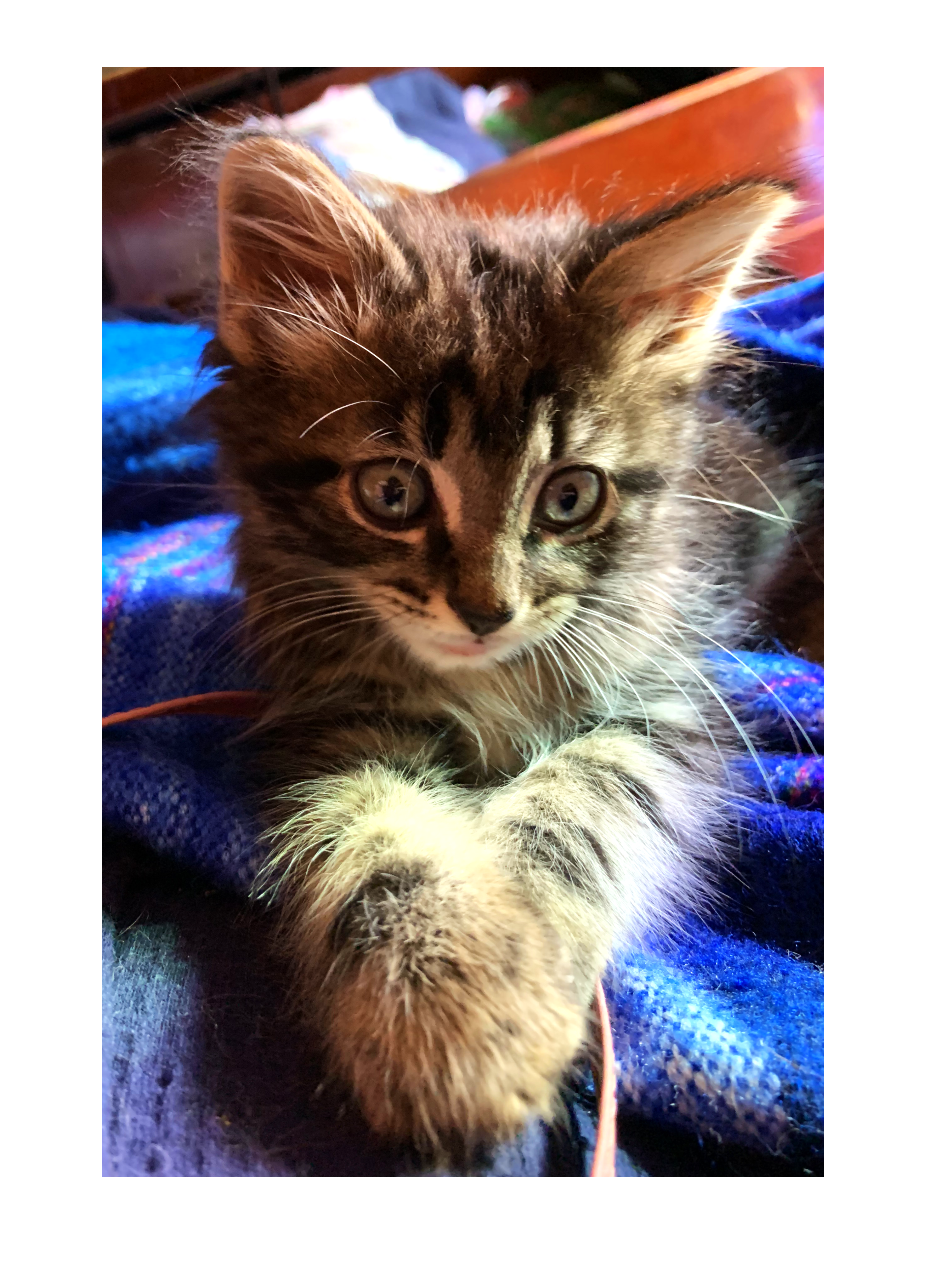
While trail walking on a rainy Spring morning in early June, my husband and sister-in-law and I heard the urgent, distressing meow of a cat in a green thicket near a creek. We thought it must be a bigger cat, given the sheer volume of its voice, but when we finally coaxed it out of the bushes, we saw that it was a tiny scrap of life, alone, soaked, starving, and full of tics and brambles. Thanks to his persistent cries, he was saved. And fed. And loved to the hilt.  

Eat, Play, Love

He-of-the-big-voice inhabits the tiniest of bodies (possibly the runt of a litter), who we hope will soon begin to fill out with our care. But tiny is huge in the realm of what matters. I realized after a week of caring for him, that he has so much to teach me. His needs are simple: Eat, play, love. But the wisdom from this relationship — kitten and me — goes much further.

Raindrop rekindles in me that foundational value of wonder that undergirds the best of spiritual traditions, poetry, science, and philosophy.

Philosophy literally means “the love of wisdom,” and I have dedicated much of my adult life to the study of philosophy and theology for this reason; but wisdom, I have discovered, comes not just from intellectual concepts, theories, and ideas; wisdom also comes to us through the wonder of nature, the earth, the body, the universe, intuition, imagination, music, art, and religious life. Wise thinking does not get caught in the hall of mirrors of its own logical certainties but returns with humility to the wonder-filled world of tiny, lost kittens and rain and the struggle to survive.

Divine Wonder

The gift of wonder comes from beyond us; it issues forth from divine places, both in heaven and earth, in sorrow and in laughter, in play and in love, in ritual and in music. The greatest thinkers are those who understand this.

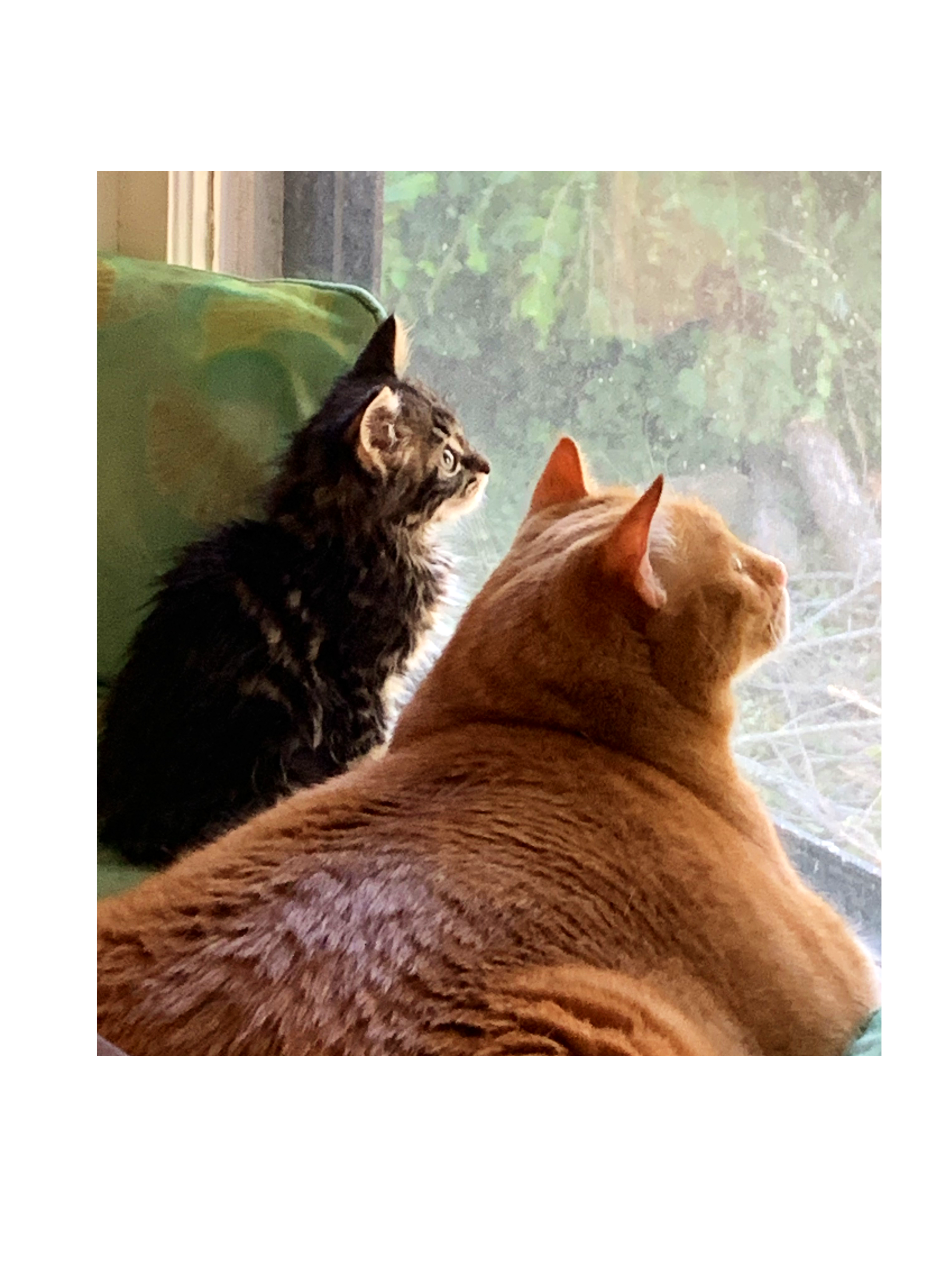
Raindrop knows something about wonder. He is full of it, all 1½ lbs. of him. Everything sings and shines and calls out to be noticed: the sounds and movements from television, a toy ball that lights up, a soft pile of towels in which to sleep and dream. Everything is brand spanking new, fresh, scary, and wonderful — everything, the whole “kit-ten” caboodle — from the ecstasy of his first lick of butter to the fear and awe inspired by his 20 lb. ginger brother.

Radical Amazement

In a state of wonder, we grow our souls, become curious and open-minded. Our creativity blossoms, and our empathy deepens. In a state of wonder, we become wholly present in the moment. Raindrop doesn’t worry about the future when watching squirrels and birds from his window perch. He doesn’t remember being abandoned and lost. He is too enraptured with life! At every turn, with every new discovery, his slanted green eyes grow large and full of nothing less than what Abraham Joshua Heschel’s called “radical amazement.”

Raindrop teaches me other things, too: when you’re in need, meow loudly until someone pays attention! Be persistent. Practice curiosity. Stand in awe at the bigness of the world. And, if everything around you is growing dark and scary, look for the patch of light streaming through the window and park yourself there as long as you need.

Be Astonished

It all begins with wonder. We can all be philosophers of wonder, with the wisdom that we are very small creatures in the scope of the vast universe. As Mary Oliver put it:

“Instructions for living a life.

Pay attention.

Be astonished.

Tell about it.”

We need these instructions more than ever. These are indisputably dark days, so it’s good to be reminded through our pets and children and poets how to live in a continuous state of awe and astonishment which keeps the door open to hope and fresh possibilities. For wonder is a form of deep intelligence that can host empathy, wholeness, and deep spiritual awakening.

The Wonder Remains

Of course, many great thinkers begin with wonder, but then lose it along the way as they get further into breaking things apart in the intellectual quest for knowledge. Things begin to be devitalized and life becomes bits and pieces of knowledge with no real embodiment. But knowledge is not wisdom. Intellectuals often forget to return their attention to what’s most real — and most important: the living, messy, ambiguous world. Good philosophy points back to the world, to nature, to the whole web of relationships that make up life. Wise thinkers balance their abstract concepts and ideas with wonder and mystery and the humility of being a tiny being in a huge universe.

It’s important to note that Whitehead did not only say, “Philosophy begins in wonder,” but he added significantly, “And at the end when philosophic thought has done its best the wonder remains.” The wonder remains! That is the key.

We all know that life itself begins in wonder, but for how many of us does wonder remain? We grow old, cynical, and forget who we are: stardust in a vast and beautiful universe — a part of the Great Mystery of Being.

Yes, Raindrop can tell us something about being a tiny tyke in a big, scary world, and how to see this vast world through a lens of wonder, awe, and pure astonishment. When I immerse myself in the wonder of my own aliveness —  the tickle of rain on my skin, the delight of a good meal, the pang of loss, the joy of finding a lost kitten — I feel a deep conviction that this tragic and beautiful world is somehow held together by love.  

And it all begins — and ends — in wonder.